Quick Answer
This article explains Spotify verification for independent artists by focusing on building a trustworthy artist profile and understanding what verification signals can and cannot prove. The practical takeaway is to verify current platform or rights rules, keep clean metadata and documentation, and make decisions based on your catalog goals rather than hype, shortcuts, or unsupported claims.
Key Takeaways
- Spotify Green Tick: Why Artists Want This Badge in 2026 is mainly about building a trustworthy artist profile and understanding what verification signals can and cannot prove.
- Artists should keep accurate metadata, release records, and rights documentation.
- Platform, marketplace, and royalty policies can change, so current rules should be verified.
- The safest plan is to protect catalog control while building sustainable audience growth.
What the New Spotify Green Tick Means for Real Artists
Spotify’s green tick is not just another badge — it is becoming a trust signal for real artists.
In 2026, Spotify verification may matter more than ever as AI profiles, fake uploads, and music spam continue to grow.
Spotify has introduced a new Verified by Spotify badge, and many artists are already calling it the new Spotify green tick.
At first, it may look like a small checkmark beside an artist profile. But for independent artists, labels, and music creators, this badge could become much bigger than a design update.
It is about trust.
In a streaming world filled with AI-generated music, fake artist profiles, duplicate uploads, impersonation, and content farms, Spotify is trying to show listeners which artist profiles have been reviewed for authenticity.
So what exactly is the Spotify green tick? Who gets it? Can AI artists get verified? And what should independent artists do now?
Let’s break it down clearly.
What Is the Spotify Green Tick?
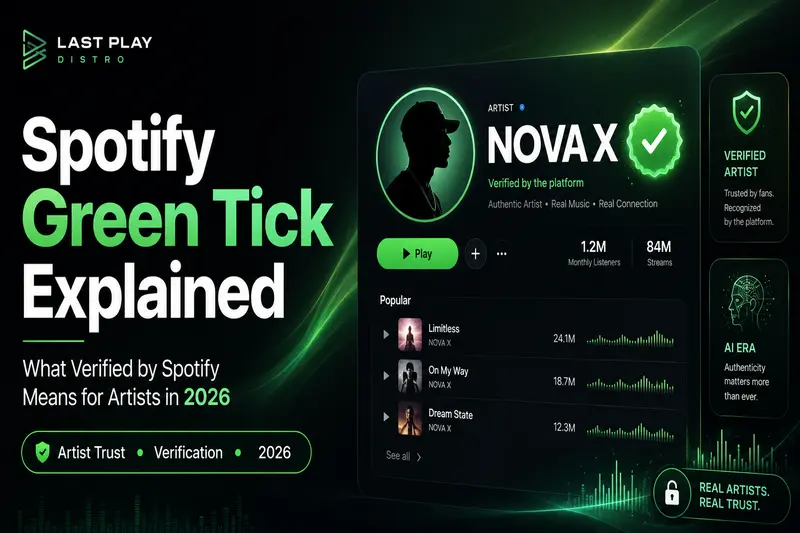
The Spotify green tick is part of Spotify’s new Verified by Spotify badge.
According to Spotify, the badge appears on an artist’s profile and in search when an artist has met defined standards for authenticity and trust. Spotify says the badge will be shown with “Verified by Spotify” text and a light green checkmark icon.
In simple words:
The green tick means Spotify has reviewed the artist profile and found enough signals that the artist behind the music is real, active, and trustworthy.
This does not mean every song by that artist is perfect.
It does not mean the artist is signed to a major label.
It does not mean the artist is automatically more talented.
But it does give listeners a quick trust signal when they search for an artist or visit their profile.
Why Did Spotify Launch the Green Tick?
Spotify is not launching this badge randomly.
The music industry is currently facing a major authenticity problem. AI tools have made it easier to generate songs, clone voices, create fake artist identities, and upload music at scale.
Spotify said in September 2025 that it had removed more than 75 million spammy tracks in the previous 12 months. The company also announced stronger enforcement against impersonation, a new music spam filtering system, and AI disclosures through music credits.
That is the bigger reason this badge matters.
Spotify is trying to protect the platform from three major problems:
- Fake artist profiles
- AI-generated personas
- Spam uploads created only to game the royalty system
For real artists, this is important because fake content can damage discovery, confuse fans, and reduce trust in streaming platforms.
Who Can Get Verified by Spotify?
Spotify says artists who receive the badge are reviewed across three main areas.
First, the artist profile should have consistent listener activity and engagement over time. Spotify is not only looking at one viral spike. It wants to see that listeners are actively and intentionally searching for the artist over a sustained period.
Second, the artist and their content should be in good standing with Spotify’s platform policies. That means no serious policy violations, deceptive behavior, or spam-style activity.
Third, Spotify looks for signals of a real artist behind the profile. These signals can include things like linked social accounts, concert dates, merch, and other artist activity both on and off Spotify.
So the badge is not just about streams.
It is about whether the artist profile looks like a real, active music identity.
Does No Green Tick Mean an Artist Is Fake?
No.
This is very important.
If an artist profile does not have the Spotify green tick yet, it does not automatically mean the artist is fake, AI-generated, or unsafe.
Spotify says verification will roll out over time because there are millions of uploaders and artist profiles on the platform. Not seeing the badge yet does not mean an artist will never receive it.
This matters especially for new independent artists.
Many new artists may be real, serious, and fully human — but they may not have enough listener activity or public artist signals yet to qualify for review.
So artists should not panic if the badge is missing.
Instead, they should focus on building real trust signals.
Can AI Artists Get the Spotify Green Tick?
At launch, Spotify says profiles that primarily represent AI-generated or AI-persona artists are not eligible for verification.
This is one of the biggest parts of the update.
Spotify is not saying all AI-assisted music is banned. Artists can still use AI tools responsibly in some creative workflows, and Spotify has also started supporting AI disclosures in music credits where artists disclose through their label or distributor.
But there is a difference between:
A real artist using AI as a tool
and
An AI persona pretending to be a real artist
The Spotify green tick is mainly focused on the second issue: artist identity and authenticity.
Spotify Green Tick vs Spotify for Artists Verification
Many artists already have access to Spotify for Artists, so this update can feel confusing.
Here is the simple difference:
Spotify for Artists access means an artist or team can manage the profile, update visuals, pitch music, and view analytics.
Verified by Spotify means Spotify has reviewed the profile for authenticity and trust signals.
So this new green tick is not the same as simply claiming your artist profile.
Claiming your profile is still important, but it may not be enough by itself.
In 2026, artists need to think beyond just distribution. They need to build a complete identity around their music.
Verified by Spotify vs AI Credits
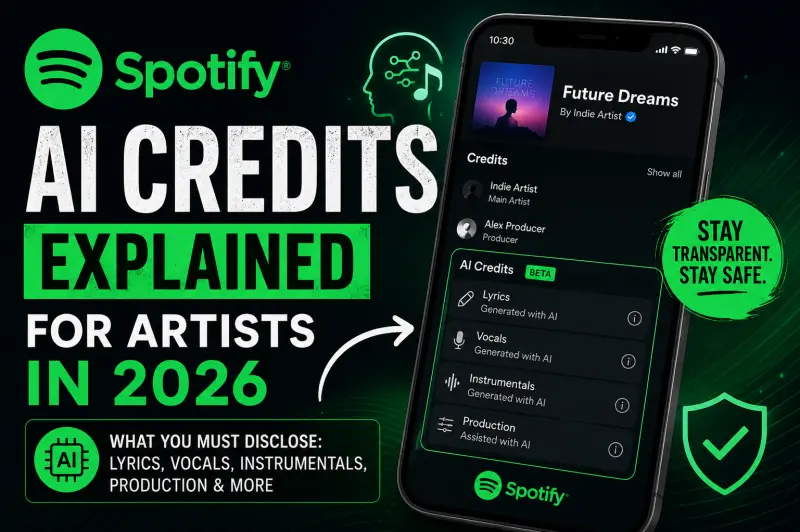
Spotify is also rolling out AI-related credits in Song Credits on mobile, where artists can disclose how AI was used in a track through their label or distributor. Spotify says this can include specific contributions like vocals, lyrics, or production.
But AI Credits and Verified by Spotify are not the same thing.
Verified by Spotify is about the artist profile.
AI Credits are about how a specific song was made.
A verified artist may still use AI tools responsibly.
An AI credit does not automatically mean a song is bad.
And no AI credit does not always prove that AI was not used, because Spotify says the system depends on artist disclosure.
This is why artists should understand both systems clearly.
One is about identity.
The other is about transparency.
Why This Badge Matters for Independent Artists
For independent artists, the Spotify green tick could become a powerful trust signal.
When fans search for an artist, a verified badge can make the profile look more official. When playlists, blogs, curators, or labels check an artist profile, verification may help create more confidence.
It may also become more important as AI music grows.
Listeners are becoming more careful about what they stream. Some fans want to know whether an artist is real, active, and connected to a genuine creative identity.
That means artists who build real visibility may have an advantage.
Not just in streams — but in trust.
How Independent Artists Can Prepare for Spotify Verification
There is no magic button to force the Spotify green tick.
But artists can improve their trust signals.
Here are practical steps:
1. Claim and update your Spotify for Artists profile
Add a professional profile image, bio, social links, artist pick, and complete branding. A dead or empty profile does not build confidence.
2. Keep your artist name consistent everywhere
Use the same artist name across Spotify, Instagram, YouTube, Apple Music, TikTok, SoundCloud, and your website. Inconsistent branding can make your identity look weak or confusing.
3. Link your real social accounts
Spotify specifically mentions linked social accounts as one of the signals of a real artist presence. Keep your socials active and connected to your music identity.
4. Avoid spam-style release behavior
Do not mass-upload low-effort tracks just to chase streams. Spotify has already discussed spam tactics like mass uploads, duplicates, SEO hacks, artificially short tracks, and content designed to exploit royalties.
5. Build real fan activity
The badge is connected to consistent listener activity and engagement over time. That means artists should focus on real fans, real searches, real saves, and real audience growth — not fake streams.
6. Use clean metadata
Wrong artist mapping, misleading titles, fake credits, duplicate metadata, and confusing releases can create problems. Your metadata should clearly represent who you are and what you released.
7. Be transparent if AI was used
If you use AI tools in vocals, lyrics, instrumentation, or production, follow the disclosure options available through your label or distributor where supported. Spotify says the industry is moving toward more nuanced AI transparency, not a simple “AI or not AI” label.
What This Means for Music Distribution in 2026
Music distribution is no longer only about uploading a song to platforms.
In 2026, distribution also means:
- clean metadata
- real artist identity
- profile protection
- transparent credits
- anti-spam compliance
- long-term trust building
This is the direction the industry is moving in.
Artists who treat streaming platforms like a quick upload machine may struggle. Artists who build a real brand, follow platform rules, and maintain clean profiles will be in a better position.
The Spotify green tick is another sign that platforms are moving toward an authenticity-based music ecosystem.
Final Verdict
The Spotify green tick is not just a small badge.
It is a signal that Spotify wants to separate real artist profiles from spam, fake identities, and AI-persona accounts.
For independent artists, this is good news — but also a warning.
Good music is still important.
But in 2026, platforms also want trust, transparency, and real identity.
If you are an artist, your next goal should not only be to upload more songs. Your goal should be to build an artist profile that looks real, active, and trustworthy everywhere your fans discover you.
Because the future of music distribution is not just about being available on platforms.
It is about being trusted on them.
FAQs
What is the Spotify green tick?
The Spotify green tick is part of the Verified by Spotify badge. It appears on eligible artist profiles and in search to show that Spotify has reviewed the profile for authenticity and trust.
Does the Spotify green tick mean an artist is human?
At launch, Spotify says profiles that primarily represent AI-generated or AI-persona artists are not eligible for verification. However, the badge is mainly a profile authenticity signal, not a full guarantee about every creative tool used in every song.
Can independent artists get Verified by Spotify?
Yes. Spotify says many independent artists are included, and the rollout is ongoing. The badge is not limited only to major-label artists.
Why does my Spotify profile not have the green tick?
Not having the badge does not automatically mean your profile is fake or rejected. Spotify says reviews are ongoing, and some artists may not yet meet the listener activity threshold or review criteria.
Is Verified by Spotify the same as Spotify for Artists?
No. Spotify for Artists lets you claim and manage your artist profile. Verified by Spotify is a separate authenticity and trust signal shown to listeners.
Should artists worry about AI Credits?
Artists should not panic, but they should be transparent. Spotify says AI disclosures are meant to give listeners more context and are not designed to punish responsible AI use.
Release Your Music Globally With Last Play Distro
With Last Play Distro, artists can distribute music globally to 150+ platforms, start on a Free tier where they keep 60% royalties, or upgrade to Premium tiers where they can keep up to 95% royalties.
- Global music distribution for independent artists
- Transparent royalties with plan-based royalty splits
- No fake partner, review, rating, or inflated artist-count claims