Quick Answer
AI content can monetize on YouTube and social platforms in 2026 when it adds original value, transparent editing, commentary, storytelling, education, or production work. Low-effort faceless videos, reused clips, synthetic voice spam, and repetitive template content are high-risk.
Key Takeaways
- AI voice or AI visuals are not automatic demonetization triggers.
- Reused content risk rises when videos are copied, lightly edited, or mass-produced without original value.
- Faceless channels need a clear creative role: scripting, analysis, editing, narration, research, or original format design.
- TikTok, Instagram, and X monetization depend heavily on account behavior, originality, music rights, and disclosure.
AI content monetization in 2026 depends less on whether AI was used and more on whether the final post is original, useful, rights-cleared, and non-deceptive. This pillar consolidates YouTube AI monetization policy, reused content rules, faceless AI channel risk, Instagram AI content, TikTok music/content monetization, and X-style social AI posting into one practical guide.
YouTube AI Monetization Baseline
YouTube does not need every video to be filmed by a human on camera. Educational animations, documentary edits, tutorials, explainers, reviews, lyric analysis, and visual essays can all be monetizable when the creator adds meaningful original work. AI becomes risky when it is used to mass-produce videos that are interchangeable, copied, misleading, or mostly recycled from other sources.
Approved-style scenario: a creator writes a script about music royalties, records or licenses an AI voice, designs custom visuals, adds examples, and edits the video into a clear explanation. The AI tools support the production, but the channel still has a human creative direction.
Rejected-style scenario: a channel auto-generates hundreds of celebrity news shorts from scraped articles, overlays stock clips, and changes only the title and thumbnail. That looks like reused or repetitive content even if the voice is technically new.
Reused Content Policy: What Actually Creates Risk
Reused content risk is about low originality. A video can fail monetization review if it mainly repackages clips, audio, images, livestreams, or social posts from elsewhere with minimal transformation. AI narration alone does not automatically make reused content original.
- Lower risk: commentary, criticism, teaching, research, data breakdowns, original edits, and case studies.
- Medium risk: AI summaries of public topics where the creator adds examples, citations, and editing.
- High risk: copied compilations, template shorts, slideshow news, synthetic voice over third-party clips, and repeated formats with no added insight.
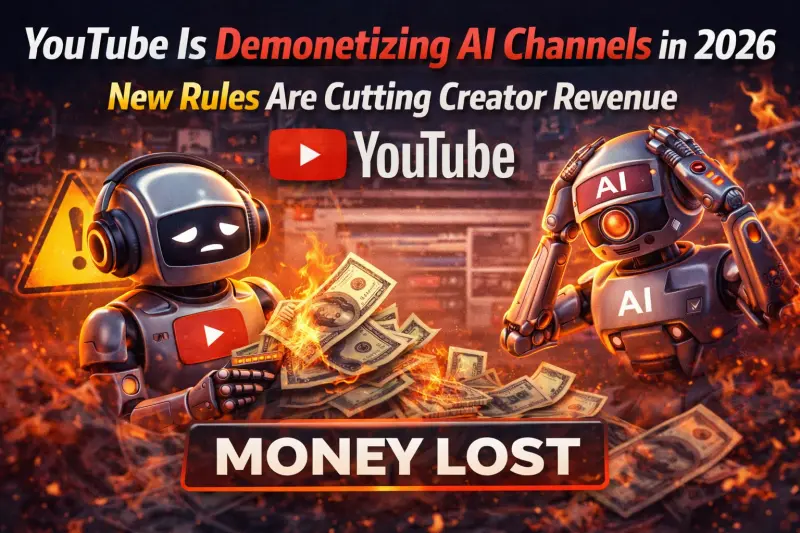
Why YouTube Is Demonetizing AI Content in 2026
YouTube's Partner Program (YPP) guidelines underwent a significant shift in 2026, leading to a wave of demonetization for channels heavily reliant on generative AI. While YouTube has stated that AI-assisted content is not banned from monetization, thousands of creators have seen their channels suspended from the program. The root cause of this demonetization wave lies in how YouTube’s automated systems and manual reviewers apply the Reused Content and Repetitive Content policies to synthetic media.
The channels most vulnerable to demonetization in 2026 are those operating "faceless cash cow" setups. These channels typically use automated tools to scrape text articles, feed them into AI text-to-speech generators, and overlay the resulting audio with generic AI-generated images or stock footage. YouTube categorizes these videos as having "minimal educational or narrative value." Because the visual asset compilation is automated and the script is non-original, the content is flagged as reused. It is not the AI voice itself that triggers demonetization; rather, it is the lack of human editing, original insights, and narrative structure that fails to meet YouTube’s quality threshold.
Furthermore, YouTube has cracked down on automated music channels. Generative music channels that upload dozens of AI-created ambient tracks, lofi beats, or soundscapes daily are being demonetized for repetitive content. If the audio waves and song structures are too similar, or if they lack human-guided instrumentation and arrangement, they are flagged as low-value, automated uploads designed to farm views. Similar issues affect AI cover song channels, where unauthorized voice models of popular singers are used to cover tracks, which violates YouTube's copyright policies and leads to immediate demonetization and strikes.
To qualify for monetization on YouTube in 2026, AI content must demonstrate substantial human transformation. Successful creators use AI to generate assets but write their own scripts, provide unique commentary, record human voiceovers (or heavily customize AI voices), and edit their videos with custom animations and pacing. The key to staying monetized is ensuring that the AI serves as a tool for production, while the creative vision and unique perspective remain indisputably human.
Faceless AI Channel Rules
A faceless channel needs a visible creative function even if the creator never appears on screen. The strongest faceless AI channels have original scripts, a consistent editorial point of view, thoughtful pacing, custom graphics, and a clear reason viewers should watch that version instead of reading the source material.
For music creators, examples include explaining royalty statements, comparing distributor fees, breaking down release strategies, reviewing music tools, or documenting a song rollout. These formats are stronger than generic countdowns or copied trend recaps.
Instagram, TikTok, and X AI Content Scenarios
Social platforms evaluate AI content through account integrity, originality, rights, and disclosure. A TikTok or Reel using AI visuals with an original song teaser can be low risk. A reposted viral clip with synthetic captions and unlicensed music can lose reach, monetization, or audio access. X-style monetization can also become unstable when posts are engagement bait, automated, or copied from other accounts.
- Instagram/Reels: protect music rights, avoid muted-audio problems, and label synthetic media when required.
- TikTok: use commercially permitted sounds for branded or monetized content and avoid repost farms.
- X/social posts: AI text is less risky when it is original analysis, not copied threads or spam automation.
Music Rights for AI and Social Monetization
Many monetization disputes begin with audio. A creator may own the video edit but not the song, beat, sample, or sound recording used underneath it. For an independent musician, this creates two different questions: can the video monetize, and can the underlying music collect royalties through Content ID or platform licensing?
A safe setup uses original music, a licensed beat, platform-approved commercial sounds, or properly cleared catalog material. Avoid using famous hooks, unlicensed remixes, or AI vocals that imitate real artists.
Case-Style Examples
Music educator channel: an AI voice explains why artists lose royalties, with original screenshots, diagrams, and examples. This has stronger monetization logic because the video teaches and transforms.
Faceless shorts channel: daily AI-generated artist facts over reused concert clips. This is high-risk because the creative value is thin and rights are uncertain.
Independent artist campaign: a musician uses AI visuals for a lyric teaser on Reels and TikTok while using their own released song. This is usually lower risk if the audio is properly distributed and the visuals do not mislead viewers.
Monetization Risk Table
| Content type | Approval condition | Main risk |
|---|---|---|
| AI explainer video | Original script, examples, editing, licensed voice | Generic summaries with no added value |
| Faceless music news | Original reporting or analysis | Scraped articles and reused clips |
| TikTok/Reels music teaser | Owned song and non-deceptive visuals | Muted audio, uncleared remix, synthetic likeness |
| AI shorts automation | Distinct concepts and human review | Spam patterns and repetitive templates |
The safest rule for creators is to make AI part of the workflow, not the entire value proposition. Platforms reward clear authorship, original utility, and clean rights.
Release Your Music Globally With Last Play Distro
With Last Play Distro, artists can distribute music globally to 150+ platforms, start on a Free tier where they keep 60% royalties, or upgrade to Premium tiers where they can keep up to 95% royalties.
- Global music distribution for independent artists
- Transparent royalties with plan-based royalty splits
- No fake partner, review, rating, or inflated artist-count claims