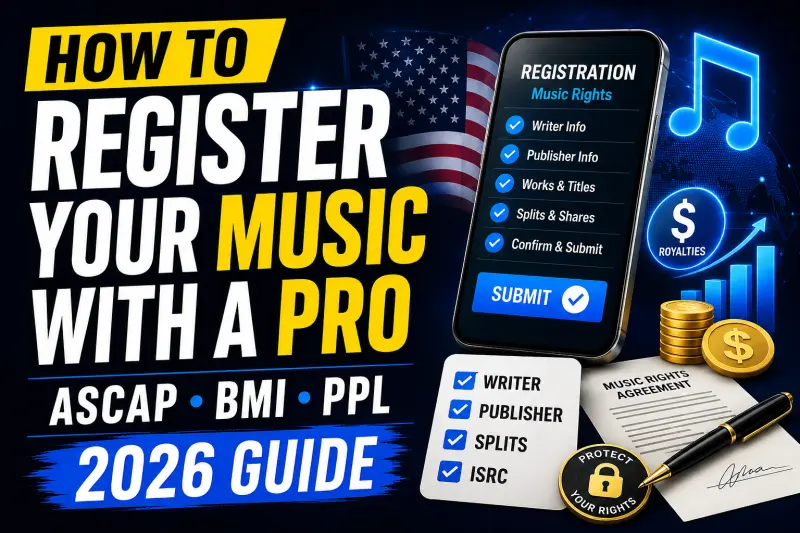
Quick Answer
This article explains PRO registration for independent artists by focusing on registering songs with performance rights organizations so performance royalties can be tracked and paid. The practical takeaway is to verify current platform or rights rules, keep clean metadata and documentation, and make decisions based on your catalog goals rather than hype, shortcuts, or unsupported claims.
Key Takeaways
- How to Register Your Music with a PRO in 2026 is mainly about registering songs with performance rights organizations so performance royalties can be tracked and paid.
- Artists should keep accurate metadata, release records, and rights documentation.
- Platform, marketplace, and royalty policies can change, so current rules should be verified.
- The safest plan is to protect catalog control while building sustainable audience growth.
How to Register Your Music with a PRO: ASCAP, BMI, PPL Step-by-Step for 2026
Your song can be streaming worldwide, used in videos, played on radio, performed live and still leave money uncollected if it is not registered with the right royalty organizations.
That is where PROs and royalty collection societies come in.
In 2026, independent artists need more than just a music distributor. A distributor can send your music to Spotify, Apple Music, YouTube, TikTok and Instagram, but it does not automatically collect every royalty your song can generate.
To collect performance royalties, publishing royalties and some international music royalties correctly, you need to register your songs with the right organization.
But there is one big confusion artists must understand first.
ASCAP, BMI and PPL Are Not the Same Type of Organization
Many artists search for “ASCAP vs BMI vs PPL” as if all three collect the same royalty.
They do not.
ASCAP and BMI are US performing rights organizations. They represent songwriters, composers and publishers for public performance royalties. ASCAP says it licenses public performances of members’ musical works, and BMI represents songwriters, composers and publishers.
PPL, on the other hand, is a UK-based organization for recorded music royalties. PPL collects for performers and recording rightsholders when recorded music is broadcast, played in public or used in certain online/international contexts.
So here is the simple difference:
- ASCAP/BMI: songwriter + publisher side
- PPL: performer + recording rightsholder side
- Distributor: master streaming royalties from DSPs
- Publisher/publishing admin: global publishing collection
- SoundExchange: US digital performance royalties for non-interactive digital radio, not YouTube videos
If you only register with one organization, you may still miss another royalty type.
What Is a PRO?
A PRO, or Performing Rights Organization, collects public performance royalties when your composition is performed, broadcast or played publicly.
This can include:
- Radio airplay
- TV broadcasts
- Live performances
- Restaurants, clubs and public venues
- Some digital performances
- Certain online uses
- Background music services
The important word is composition.
A PRO usually collects for the song itself — the melody, lyrics and composition — not simply the audio recording. That means the songwriter and publisher side must be registered properly.
Why Artists Need to Register Songs Manually
Many independent artists think:
“My distributor already uploaded my song. So my royalties are covered.”
That is not fully true.
Your distributor usually collects master-side streaming income from platforms. But PRO royalties are linked to the composition, not only the recording.
If your song is not registered with your PRO, the society may not know:
- Who wrote the song
- What percentage each songwriter owns
- Who controls the publisher share
- Which ISRC belongs to the recording
- Which title variations belong to the same song
- Where to send the royalties
BMI’s royalty policy says songs must be submitted through a BMI registration form to receive credit for certain types of performances, including radio, commercial music services, live concerts and internet uses.
That means uploading music is not enough. Registration matters.
Step 1: Choose the Right PRO or Collection Society
Before registering songs, choose the correct organization based on your country, royalty type and role.
For US-based songwriters, the main PRO choices are usually:
- ASCAP
- BMI
- SESAC, invitation-based
- GMR, invitation-based
For UK-based songwriters, PRS for Music is the main performance rights society. PRS says writers should register their music so PRS can track use online, in broadcast and in public places.
For performers and recording owners in the UK or international neighboring-rights collection, PPL is relevant. PPL says anyone who performed on recorded music can join as a performer, and recordings registered with PPL may generate royalties when played publicly or broadcast.
For US digital radio/non-interactive streaming, SoundExchange is important because it collects digital performance royalties and pays featured artists, non-featured artists and rights owners according to statutory splits.
Step 2: Join as a Writer
If you write lyrics, compose melodies, create toplines or produce original compositions, you should usually join as a writer.
ASCAP says joining as a writer is free for new writer members.
BMI also says it is fast, easy and free to join for songwriters, publishers and composers.
When joining, you may need:
- Legal name
- Artist name
- Email address
- Date of birth
- Address
- Tax details
- Bank/payment details
- IPI/CAE number if you already have one
- Songwriter role information
Once your account is created, you can start registering works.
Step 3: Decide If You Need a Publisher Account
This is where many artists lose money.
Performance royalties are commonly split into:
- Writer share
- Publisher share
ASCAP says when it distributes performance royalties, 50% goes to writers and 50% goes to publishers. If you want to collect the publisher share directly, you need a publisher membership or a publisher/admin setup.
If you are fully independent and you own your own publishing, you may need to set up a publishing entity or use a publishing administrator.
A simple rule:
If you only join as a writer, you may collect your writer share.
If you also control publishing, you need a way to collect the publisher share too.
Step 4: Prepare Your Song Metadata
Before registering a song, collect all metadata in one place.
You need:
- Song title
- Alternate title, if any
- Artist name
- Legal names of writers
- Songwriter splits
- Publisher names
- Publisher splits
- ISRC
- UPC
- Release date
- Recording title
- Performer names
- Producer names, if relevant
- Lyrics language
- Territory information
- Existing ISWC, if available
Do not guess songwriter splits later. Finalize them before registration.
For example:
| Contributor | Role | Share |
|---|---|---|
| Artist A | Writer / Composer | 50% |
| Artist B | Lyricist | 25% |
| Producer C | Composer | 25% |
If the splits are wrong, royalty payments can be delayed, disputed or misallocated.
Step 5: Register the Song with ASCAP
If you use ASCAP, log in to your ASCAP account and register the work.
ASCAP supports work registration through Quick Registration or Guided Registration, where members provide writer, publisher and royalty split details.
Typical ASCAP registration steps:
- Log in to your ASCAP Member Access account
- Go to work registration
- Choose Quick Registration or Guided Registration
- Add song title
- Add alternate titles, if any
- Add all writers and shares
- Add publisher information
- Add performer/artist name
- Add ISRC if available
- Review and submit
Best practice: register the song after release metadata is final, but do not wait too long after release.
Step 6: Register the Song with BMI
If you use BMI, log in to your BMI account and register the work from your creator dashboard.
BMI’s royalty policy says works must be submitted through BMI registration to receive credit for certain performance types.
Typical BMI registration steps:
- Log in to BMI
- Open work registration
- Enter song title
- Add performing artist
- Add all writers
- Add ownership percentages
- Add publisher details
- Add ISRC and release details
- Confirm the information
- Submit the work
Do not register the same song twice with conflicting data. If the song has already been registered by a co-writer or publisher, coordinate before submitting.
Step 7: Register with PPL If You Are a Performer or Recording Rightsholder
PPL is not the same as ASCAP or BMI. It focuses on recorded music rights, performers and recording rightsholders.
PPL says royalties are calculated at track and individual performer level, based on music usage matched with the PPL Repertoire Database. It also states UK royalties are paid annually in June, with other payments including quarterly international payments.
You should consider PPL if:
- You performed on the recording
- You own the master recording
- You control a label catalog
- Your music is played in the UK
- Your music is broadcast internationally
- You want neighboring-rights collection
Typical PPL steps:
- Create a PPL member account
- Choose performer and/or recording rightsholder role
- Add personal or company details
- Add performer line-up information
- Register recordings
- Add ISRCs
- Add track titles and artist names
- Add rights ownership details
- Submit and monitor claims
For UK publishing royalties, do not confuse PPL with PRS. PRS for Music and PPL are separate organizations licensing different rights. PRS works with songwriters, composers and publishers, while PPL licenses recorded music for performers and record companies.
Step 8: Register Live Performances
Live shows can generate royalties too.
If you perform your songs live, submit setlists where your PRO allows it. This is especially important for independent artists who play clubs, festivals, college shows, tours or showcases.
Live performance data should include:
- Event name
- Venue name
- City and country
- Date
- Setlist
- Song titles
- Your writer account information
Do not ignore live royalties. Small shows may not look important individually, but regular performance history can build long-term royalty income.
Step 9: Register Every New Song, Not Just Your Biggest Songs
A common mistake is registering only viral songs.
Register every original song you release.
Even a smaller track can later be used in:
- YouTube videos
- TV background music
- Radio shows
- Podcasts
- Live sets
- Sync placements
- International broadcasts
- Venue playlists
If the song is not registered correctly, the royalty trail becomes harder to claim later.
Step 10: Check International Royalty Collection
If your audience is global, domestic registration may not be enough.
ASCAP says foreign performance royalties are collected through agreements with foreign societies and then distributed to members.
PPL also offers international collections for performers and recording rightsholders whose recorded music has been played outside the UK.
SoundExchange says it works with international partners through 96 agreements with 74 CMOs to collect performance royalties when music is played overseas.
For independent artists, the best setup may include:
- PRO for performance royalties
- Publishing administrator for global publishing collection
- Distributor for master streaming royalties
- SoundExchange for US digital radio royalties
- PPL or neighboring rights organization for performer/master-side neighboring rights
ASCAP vs BMI vs PPL: Which One Should You Choose?
Here is the simple breakdown.
| Organization | Best For | Royalty Type |
|---|---|---|
| ASCAP | US songwriters and publishers | Performance royalties |
| BMI | US songwriters and publishers | Performance royalties |
| PPL | Performers and recording owners | Neighboring/recorded music royalties |
| PRS | UK songwriters and publishers | Performance royalties |
| SoundExchange | US digital radio/non-interactive streams | Digital performance royalties |
If you are a US-based songwriter, you usually choose one PRO like ASCAP or BMI.
If you are a UK performer or recording owner, PPL may also matter.
If you are a songwriter in the UK, PRS is more relevant for the composition side than PPL.
If you are both the artist and songwriter, you may need more than one royalty setup.
Common Mistakes Artists Make
1. Registering only with a distributor
Distribution is not the same as PRO registration.
2. Forgetting the publisher share
If you own your publishing but do not collect the publisher share, you may leave money behind.
3. Wrong songwriter splits
Splits should be finalized before release.
4. Missing ISRC
The ISRC connects the recording to usage data. Keep it consistent.
5. Confusing PPL with ASCAP/BMI
PPL is mainly for recorded music/performance rights, not the same as US songwriter PROs.
6. Waiting too long to register
Register songs as soon as your metadata is final.
7. Not registering live shows
Live performance royalties can matter, especially for active performers.
Best Registration Checklist for 2026
Before releasing your next song, complete this checklist:
- Choose your PRO or society
- Join as a writer
- Set up publisher collection if needed
- Confirm songwriter splits
- Confirm publisher splits
- Save ISRC and UPC
- Register the song with your PRO
- Register recordings with PPL or neighboring rights body if applicable
- Register with SoundExchange if relevant
- Submit live performances
- Keep payment and tax details updated
- Review royalty statements regularly
Final Verdict
In 2026, registering your music with a PRO is not optional if you want to collect royalties properly.
ASCAP and BMI help songwriters and publishers collect performance royalties. PPL helps performers and recording rightsholders collect recorded music royalties in the UK and internationally. SoundExchange can help with US non-interactive digital performance royalties.
The smartest move is to build a complete royalty system:
Distributor for master streaming income.
PRO for songwriter performance royalties.
Publisher or publishing admin for publisher-side collection.
PPL or neighboring rights society for performer/master-side royalties.
SoundExchange for non-interactive digital radio royalties.
Your song should not just be released. It should be registered, tracked and ready to earn from every possible royalty source.
FAQ
Do I need ASCAP or BMI if I already use a distributor?
Yes. A distributor usually collects master-side streaming royalties, while ASCAP or BMI collects performance royalties for the composition side.
Can I join both ASCAP and BMI?
Usually, you should not register the same writer with both for the same catalog. Pick the PRO that fits your needs and avoid conflicting registrations.
Is PPL the same as BMI?
No. BMI collects songwriter/publisher performance royalties in the US. PPL collects recorded music royalties for performers and recording rightsholders, mainly in the UK and through international collections.
Do producers need a PRO?
Yes, if the producer has a songwriter/composer share in the composition. If the producer only owns a master royalty or producer royalty but no composition share, the setup may be different.
Do I need a publisher account?
If you control your publishing and want to collect the publisher share directly, you need a publisher setup or publishing administrator.
Should independent artists register every song?
Yes. Every original song should be registered with the correct PRO or collection society to avoid missing royalties later.
Does PPL collect Spotify royalties?
PPL focuses on recorded music royalties from uses such as public performance, broadcast and certain international uses. Normal Spotify master streaming royalties are usually collected through your distributor.
Release Your Music Globally With Last Play Distro
With Last Play Distro, artists can distribute music globally to 150+ platforms, start on a Free tier where they keep 60% royalties, or upgrade to Premium tiers where they can keep up to 95% royalties.
- Global music distribution for independent artists
- Transparent royalties with plan-based royalty splits
- No fake partner, review, rating, or inflated artist-count claims