Quick Answer
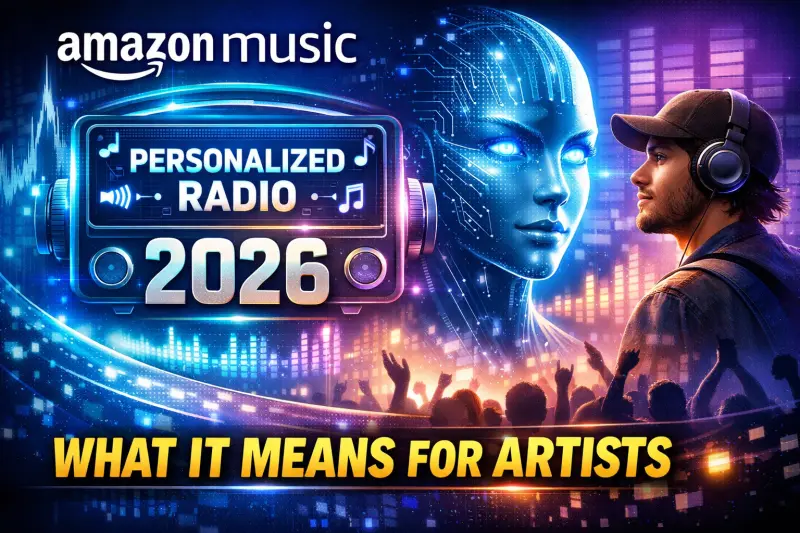
This article explains Amazon Music AI radio for independent artists by focusing on preparing songs and metadata for more personalized recommendation environments. The practical takeaway is to verify current platform or rights rules, keep clean metadata and documentation, and make decisions based on your catalog goals rather than hype, shortcuts, or unsupported claims.
Key Takeaways
- Amazon Music Launches AI-Powered Personalized Radio in 2026 is mainly about preparing songs and metadata for more personalized recommendation environments.
- Artists should keep accurate metadata, release records, and rights documentation.
- Platform, marketplace, and royalty policies can change, so current rules should be verified.
- The safest plan is to protect catalog control while building sustainable audience growth.
🎧 What Did Amazon Music Announce in January?
In early January 2026, Amazon Music began rolling out AI-powered Personalized Radio, a system that:
-
Builds live radio streams for each listener based on their immediate preferences
-
Adapts instantly to listening behavior, skips, and session durations
-
Mixes known favorites with new, unheard tracks from independent artists
Unlike playlists, these radios constantly evolve in real time, offering a continuous soundscape that changes as the listener interacts with it.
🤖 How AI-Powered Radio Works
Amazon’s AI analyzes a multi-dimensional array of inputs to curate the feed:
-
Listening duration: Does the listener stay for the entire song, or just the first few bars?
-
Skips vs full plays: Immediate skips trigger the algorithm to adjust the subsequent tracks' mood, tempo, and style parameters.
-
Time of day & mood patterns: The AI builds contextual queues matching morning routines, work sessions, workouts, or evening relaxation.
-
Voice requests via Alexa: Integrating natural language processing to decode abstract requests (e.g., "Alexa, play something upbeat for writing code").
-
Genre-to-genre transitions: Smoothly bridging different styles based on acoustic profiling rather than static genre folders.
Instead of fixed playlists, users get a never-ending, adaptive radio experience that learns and adapts to their lifestyle.
🌍 Why This Is a Big Deal (Globally)
This update matters because:
-
Radio listening is rising again: Global listeners are experiencing fatigue from maintaining and curating static playlists, driving demand for hands-off audio curation.
-
Passive discovery beats manual searching: Algorithms are getting better at predicting user taste, reducing the friction of finding new music.
-
Voice-controlled music is growing fast: Smart speaker adoption has surged globally, making voice-based discovery the default interface in living rooms, cars, and offices.
Amazon is clearly positioning itself against Spotify and Apple Music in long-term discovery wars.
📈 What This Means for Artists
✅ Potential Benefits
-
Smaller artists can surface organically: Because recommendations are based on acoustic profiling and immediate listener behavior rather than social popularity, a great-sounding track from an unknown producer can get pushed into rotation side-by-side with mainstream hits.
-
Songs with strong retention perform better: High completion rates act as a positive signal, multiplying your exposure without expensive marketing campaigns.
-
No playlist pitching required: Algorithmic distribution bypasses human gatekeepers, reducing the need for costly editorial pitches.
⚠️ Possible Risks
-
Skip-heavy tracks lose visibility: Songs that fail to engage the listener in the first 15 seconds are quickly filtered out of recommendations.
-
Short-term hype songs may fade faster: If listeners click because of a trend but skip before completion, the algorithm stops recommending the song.
-
Metadata accuracy matters more than ever: If your track is categorized poorly or lacks detailed tag descriptors, the AI won't know when to play it.
Discovery is now behavior-driven, not popularity-driven.
🎯 How Artists Can Optimize for AI Radio in 2026
To increase chances of being picked by Amazon's AI radio:
-
Focus on strong intros: The first 15–30 seconds matter. Hook the listener immediately and avoid excessively long, silent, or confusing intro sequences.
-
Maintain consistent and detailed metadata tagging: Make sure your distributor submits exhaustive genre, sub-genre, mood, and instrumental details to the streaming stores.
-
Avoid misleading titles or artwork: Bait-and-switch tactics trigger quick skips, which signals the algorithm to deprioritize your track.
-
Encourage full listens: Direct your fans from social media to play your tracks in full, signaling high engagement to the platform algorithms.
AI favors listener satisfaction, not marketing tricks.
🔊 The Alexa Advantage
Because Amazon Music is deeply connected with Amazon Alexa, voice commands like:
“Play something chill but not sad”
“Play new electronic music I might like”
are now driving massive discovery — especially in smart-speaker households. The system relies on semantic search models to parse abstract requests. For example, if a user asks for "morning coffee vibes," the AI translates this into acoustic characteristics like tempo (BPM), instrumentation (acoustic guitar, piano), and dynamic range, then matches it against indexed tracks. Ensuring your track's metadata has rich descriptive tags makes it much easier for Alexa's voice parser to retrieve it.
🏠 Smart Speaker Curation and the Smart Home Integration
In smart home ecosystems, listeners rarely ask for specific song names. Instead, they request auditory backgrounds matching physical environments (e.g., "Alexa, play quiet kitchen music" or "Alexa, play study sounds for the kids"). Amazon Music's personalized AI radio handles these requests by translating user contexts into acoustic metadata targets. For artists, this means that optimizing metadata goes beyond basic genre labels. You must tag your releases with descriptive categories indicating dynamic properties (e.g., acoustic, electric, ambient, driving), tempos, and key signatures. By ensuring that your distribution platform delivers these detailed acoustic descriptors to Amazon Music, you increase the likelihood that Alexa's recommendation query matches your track, driving discovery among smart home users.
🔮 What This Signals for the Music Industry
This update shows a clear trend:
Platforms are shifting from playlists to AI-led listening journeys.
Artists who understand how algorithms read behavior will gain long-term exposure without paid promotion, making quality and listener retention the ultimate metrics of success.
✅ Final Takeaway
Amazon Music’s AI radio isn’t about replacing artists.
It’s about replacing static discovery.
In 2026, the future of streams belongs to music that keeps listeners listening.
Release Your Music Globally With Last Play Distro
With Last Play Distro, artists can distribute music globally to 150+ platforms, start on a Free tier where they keep 60% royalties, or upgrade to Premium tiers where they can keep up to 95% royalties.
- Global music distribution for independent artists
- Transparent royalties with plan-based royalty splits
- No fake partner, review, rating, or inflated artist-count claims