Quick Answer
A waterfall release strategy means releasing singles one by one, then combining them into a larger EP or album so each track gets its own promotion window. For independent artists, it can keep a campaign active longer, create repeated pitching moments, and give listeners several entry points before the full project arrives.
Key Takeaways
- Waterfall releases work best when each single has its own story and promotion window.
- The strategy helps artists avoid spending all attention on one release day.
- Metadata and track order need planning so earlier singles connect cleanly to the final project.
- A waterfall campaign should still prioritize quality content, audience data, and realistic timelines.
Waterfall Release Strategy: How Independent Artists Get More Streams in 2026
One song can disappear in 24 hours.
A smart release plan can keep the same project alive for months.
For independent artists in 2026, dropping a full EP or album without a rollout is risky. Attention is short, playlist competition is heavy, and most listeners do not discover an artist from one random release day. That is why many artists are using the waterfall release strategy to stretch one project into multiple release moments.
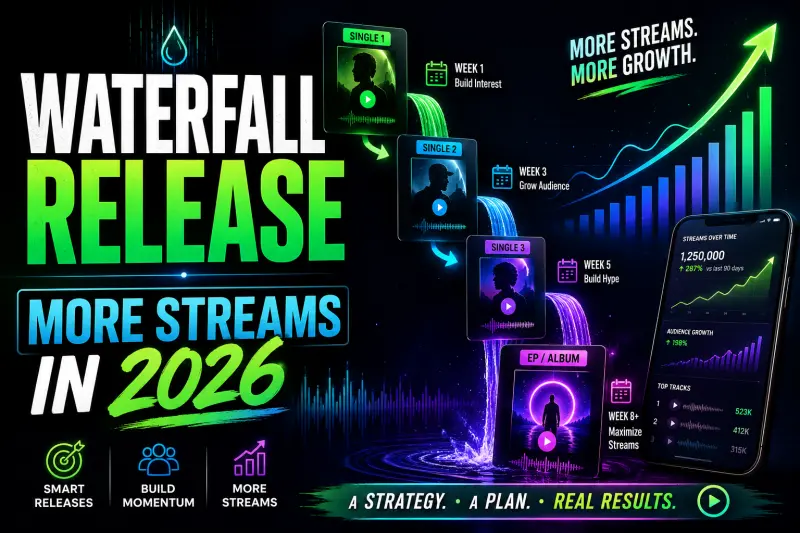
A waterfall release strategy helps you release songs one by one while building toward a bigger EP or album. Instead of dropping everything at once, you give every track its own chance to get saves, playlist adds, social content, and algorithmic signals.
The important thing is this: waterfall release is not a magic streaming hack. It works only when every single has a real promotion plan behind it.
What Is a Waterfall Release Strategy?
A waterfall release strategy is a rollout method where an artist releases songs gradually and keeps adding the previous songs into each new release.
For example, if you have a 5-song EP, the rollout can look like this:
Release 1: Song A
Release 2: Song A + Song B
Release 3: Song A + Song B + Song C
Release 4: Song A + Song B + Song C + Song D
Final Release: Full EP with all 5 songs
This creates multiple release moments from one project instead of only one release day. UnitedMasters describes waterfall as a strategy used to build momentum around a project, not a separate release type.
Why Waterfall Releases Work Better in 2026
In 2026, music discovery is not only about uploading a song. It is about creating repeated signals.
A single release gives you one campaign window. A waterfall rollout gives you multiple campaign windows. Every new drop becomes another reason to post content, pitch the song, email fans, run ads, update playlists, and push listeners back to the project.
Spotify also allows artists to pitch upcoming unreleased music through Spotify for Artists. Spotify says that if a song is pitched at least 7 days before release, it can be added to followers’ Release Radar playlists.
That matters because a waterfall strategy gives you more unreleased songs to pitch over time, instead of depending on one full-project release.
How Independent Artists Get More Streams From Waterfall Releases
The main benefit is not that platforms “boost” waterfall releases automatically. The benefit is that you create more opportunities for listeners to hear the same project.
When Song B comes out with Song A included, new listeners may play Song B and then discover Song A. When Song C comes out with Song A and Song B included, your older songs get another chance to collect streams.
This can help with:
Saves
Repeat listens
Playlist adds
Follower growth
Release Radar activity
Social media momentum
More consistent monthly listeners
The strategy works best when every song feels like a new event, not just another upload.
Best Waterfall Release Timeline for Independent Artists
For most independent artists, a good waterfall schedule is:
Week 1: Release first single
Week 4 or 5: Release second single with first single included
Week 8 or 9: Release third single with previous songs included
Week 12: Release final EP or album
You can also space songs every 2–4 weeks if you already have strong content, visuals, and promotion ready. Symphonic recommends planning the sequence ahead of time, treating each track like its own mini-release, and keeping the bigger project connected visually and creatively.
For smaller artists, 4 weeks between drops is usually safer because it gives enough time to promote each song properly.
Step-by-Step Waterfall Release Plan
1. Choose the Strongest First Song
Your first song should be the easiest one to understand. Do not start with the most experimental track unless your audience already expects that from you.
Pick the song with the strongest hook, best short-form video potential, and clearest emotion.
The first release is the entry point. If it feels weak, the whole rollout becomes harder.
2. Keep the Same Artwork Style
Every waterfall release should feel connected.
You can change the title and tracklist, but the visual identity should stay consistent. Use the same color palette, font style, logo placement, and mood across every cover.
This helps fans recognize that every single belongs to the same bigger project.
3. Pitch Every Eligible Single
Do not wait until the final EP or album. Pitch each unreleased single before it goes live.
Spotify’s official guidance says playlist pitches must be submitted through Spotify for Artists while the song is still upcoming and unreleased.
Your pitch should not sound generic. Instead of writing:
“This is my new pop song. Please consider it.”
Write something more specific:
“A late-night emotional pop track about losing someone but still checking their profile. Best fit for heartbreak, sad pop, chill night, and emotional drive playlists.”
Editors and algorithms both need context. Give the platform clear genre, mood, language, instruments, and audience signals.
4. Build a Content Plan for Every Drop
Waterfall strategy fails when artists upload songs but do not promote them.
For every single, prepare:
10 short-form videos
1 behind-the-scenes clip
1 lyric video
1 visualizer
3 story posts
1 email or WhatsApp broadcast
1 playlist push
1 creator/influencer outreach list
Every release needs its own campaign.
5. Use Smart Links and Pre-Saves
Create one smart link for each release and keep updating your audience before every drop.
For Apple Music, pre-adds allow listeners to add upcoming music to their library before release, and Apple says listeners are notified when the album becomes available.
This is useful for waterfall rollouts because your final EP or album can already have early interest before it drops.
6. Keep Old Songs Alive
Do not stop promoting Song A after Song B comes out.
That is the whole point of waterfall.
When Song B drops, make content like:
“Start from track 1 before listening to the new one.”
“This story continues from the last song.”
“Part 2 of the same heartbreak.”
“Listen in order for the full story.”
You are not only promoting the newest song. You are promoting the full journey.
Common Waterfall Release Mistakes
Mistake 1: Releasing Too Fast
If you release every week without promotion, you may burn the project quickly. Most independent artists need time to create demand.
Fast rollout only works when you already have a strong audience or a lot of content ready.
Mistake 2: No Story Between Songs
A waterfall release should feel connected. If every song has a different sound, artwork, and message, fans may not understand why they should follow the rollout.
Give the project a theme.
For example:
A heartbreak story
A party EP
A summer project
A devotional album
A motivational rap series
A sad romantic acoustic rollout
Mistake 3: Treating It Like a Spotify Trick
Waterfall releases do not guarantee streams. They simply give your campaign more chances to work.
NotNoise recently explained this well: a waterfall release creates more campaign moments, but it does not magically multiply your audience.
If the song is weak, the content is weak, or the audience is not engaged, the strategy will not save the release.
Mistake 4: Wrong Metadata or ISRC Handling
When you include previously released songs in a new waterfall release, make sure the metadata is correct.
The old songs should keep their original ISRCs where required so streams and track history are not split incorrectly. Always check your distributor’s waterfall rules before submitting.
Best Type of Artists for Waterfall Strategy
Waterfall release works best for artists who have:
At least 3–6 finished songs
A clear visual identity
Consistent social media activity
A story or theme behind the project
Time to promote every release
Fans who respond to singles better than albums
It is especially useful for independent artists because it gives them more content without needing to create a new song every week.
Waterfall vs Full Album Drop: Which Is Better?
For most independent artists in 2026, waterfall is better than dropping a full album without a rollout.
A full album gives you one big moment. A waterfall rollout gives you multiple moments.
However, a full album drop can still work if you already have:
A large fanbase
Strong press support
A tour announcement
A major collaboration
A viral song already building demand
For emerging artists, the safer move is usually to release singles first, build momentum, and then drop the full project.
Simple 12-Week Waterfall Plan
Here is a clean rollout plan independent artists can follow:
Week 1: Release Single 1
Focus: introduction, reels, playlist pitching, saves
Week 4: Release Single 2 with Single 1
Focus: story continuation, fan retargeting, short-form clips
Week 8: Release Single 3 with previous songs
Focus: playlist push, creator outreach, performance comparison
Week 12: Release full EP
Focus: full project campaign, email list, press, fan playlist, behind-the-scenes content
This keeps your artist profile active for three months instead of relying on one release day.
Final Verdict
The waterfall release strategy is one of the smartest music release strategies for independent artists in 2026.
It gives every song its own spotlight, keeps your audience engaged longer, and creates more chances for saves, playlist adds, Release Radar activity, and repeat streams.
But it only works when you treat every single like a real release.
Do not use waterfall because you want to “trick” Spotify. Use it because your project deserves more than one day of attention.
FAQ
What is a waterfall release in music?
A waterfall release is a strategy where an artist releases songs one by one while adding previous songs into each new release, eventually building toward a full EP or album.
Does waterfall release increase streams?
It can help increase streams by creating multiple release moments and bringing attention back to older songs, but it does not guarantee results. Promotion, song quality, and audience engagement still matter.
How many songs do I need for a waterfall release?
A waterfall strategy works best with at least 3 songs. For an EP or album, 4–6 songs can create a stronger rollout.
How far apart should waterfall releases be?
Most independent artists should release every 3–5 weeks. This gives enough time for promotion, playlist pitching, and content creation.
Can I pitch every waterfall single to Spotify?
Yes, if the song is upcoming and unreleased, you can pitch it through Spotify for Artists. Spotify recommends pitching at least 7 days before release for Release Radar eligibility.
Is waterfall release good for new artists?
Yes, it can be very useful for new artists because it creates more chances to build awareness instead of depending on one album drop.
Release Your Music Globally With Last Play Distro
With Last Play Distro, artists can distribute music globally to 150+ platforms, start on a Free tier where they keep 60% royalties, or upgrade to Premium tiers where they can keep up to 95% royalties.
- Global music distribution for independent artists
- Transparent royalties with plan-based royalty splits
- No fake partner, review, rating, or inflated artist-count claims