Quick Answer
This article explains streaming compensation for independent artists by focusing on how platform revenue, rights holders, territories, and agreements affect artist payouts. The practical takeaway is to verify current platform or rights rules, keep clean metadata and documentation, and make decisions based on your catalog goals rather than hype, shortcuts, or unsupported claims.
Key Takeaways
- Artist Compensation Music Streaming Platforms 2026 is mainly about how platform revenue, rights holders, territories, and agreements affect artist payouts.
- Artists should keep accurate metadata, release records, and rights documentation.
- Platform, marketplace, and royalty policies can change, so current rules should be verified.
- The safest plan is to protect catalog control while building sustainable audience growth.
🌍 The Big Picture: Streaming Revenue in 2026
Streaming dominates the music industry in 2026 — but artist earnings remain widely misunderstood.
Behind every stream lies a complex revenue system that rewards engagement, not just volume.
This guide explains how music streaming services distribute revenue today, what has changed in 2026, and how independent artists can adapt.
Streaming now represents over 80% of global recorded music revenue, driven by:
-
Paid subscriptions
-
Ad-supported listening
-
Price increases across major platforms
Most platforms follow the same core rule:
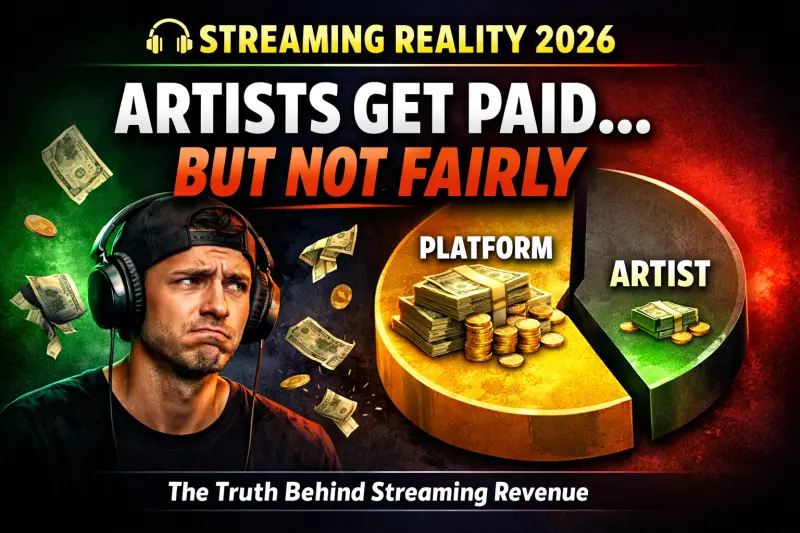
Roughly 70% of platform revenue is distributed to rights holders — artists, labels, publishers, and songwriters.
The difference lies in how that pool is divided.
💰 How Streaming Revenue Is Distributed
The Pro-Rata Model (Still Dominant)
Used by Spotify, Apple Music, and Amazon Music.
-
All revenue goes into one pool
-
Artists earn based on their share of total streams
-
If your songs get 1% of total streams, you earn ~1% of the pool
This favors high-volume artists, not necessarily the most dedicated fanbases.
🎯 Per-Stream Payouts in 2026 (Estimated Averages)
There is no fixed rate per stream. Values depend on country, subscription tier, and engagement.
| Platform | Avg. Payout per 1,000 Streams |
|---|---|
| Qobuz | ~$40 |
| Tidal | $6 – $9 |
| Apple Music | $5.50 – $8 |
| Amazon Music | $4 – $6 |
| Spotify | $3 – $5 |
| YouTube Music | ~$2 |
These figures are before distributor or label cuts.
🔄 2026 Shift: Artist-Centric & Weighted Models
2026 marks the end of “every stream is equal.”
Key Changes:
-
1,000-stream minimum thresholds before tracks earn royalties
-
Higher value for active listening (searching, saving, repeat plays)
-
Reduced value for passive or background streams
Platforms like Deezer now apply multipliers for artists with real, engaged audiences.
🤖 The AI & “Functional Audio” Crackdown
With over 250 million tracks now available globally, platforms are cleaning catalogs.
2026 policies target:
-
AI-generated bulk uploads
-
Functional noise (rain, sleep loops, ASMR spam)
-
Low-effort, engagement-free content
Results:
-
Stricter eligibility rules
-
Algorithmic demotion
-
Revenue redirected to active creators
This protects the royalty pool — but raises the bar.
📈 Why Subscription Price Hikes Matter
Subscription prices increased across major platforms in 2025–26.
This matters because:
-
Higher subscription revenue = larger royalty pool
-
If total streams stay stable, per-stream value increases
For the first time in years, mid-tier artist earnings are rising, not just superstar payouts.
🚧 Challenges Independent Artists Still Face
Despite growth:
-
Top 1% of artists still capture most revenue
-
Free tiers dilute payout value
-
Discovery without engagement no longer works
Streaming alone is not a sustainable income model for most artists.
🧠 Smart Strategies for Artists in 2026
To survive in the engagement-weighted era:
✅ Focus on Active Fans
-
Encourage saves, follows, and searches
-
Build repeat listeners, not viral spikes
✅ Target High-Value Markets
-
Premium listeners generate more revenue
-
Quality engagement > global volume
✅ Own Your Masters
-
Royalty pass-through matters more than ever
-
Distribution control = income control
✅ Diversify Revenue
-
Licensing, merch, touring, direct-to-fan models
🔮 The Future of Artist Compensation
The “gold rush” phase of streaming is over.
2026 marks the Age of Engagement.
Success is no longer about how many people heard your song —
but how many chose to hear it.
Artists who understand this shift will grow sustainably.
Those who ignore it will slowly disappear from payouts.
🏁 Final Takeaway
Streaming is still powerful — but only for artists who adapt.
In 2026, attention without engagement has no value.
At Last Play Distro, our goal is simple:
Help artists navigate this system — and keep what they earn.
Release Your Music Globally With Last Play Distro
With Last Play Distro, artists can distribute music globally to 150+ platforms, start on a Free tier where they keep 60% royalties, or upgrade to Premium tiers where they can keep up to 95% royalties.
- Global music distribution for independent artists
- Transparent royalties with plan-based royalty splits
- No fake partner, review, rating, or inflated artist-count claims